


Overview
THE BRIEF
Design and build a functional, lightweight, visually compelling occasional table with a defined purpose. Its form, personality, and materials should tell a clear story behind its scale, use, and where it lives.
THE CONSTRAINTS
Minimum surface height: 12 inches above the ground. Final constructed size: between 12” x 12” x 12” and 22” x 22” x 22”. Must be structurally capable of supporting the weight of someone who might accidentally sit on it.
ROLE
Solo Designer
CONTEXT
Second-Year Studio
DURATION
6.5 Weeks, Spring 2026
ADVISOR
Thomas Clifton
Research
WOODSHOP RESEARCH · SITE VISITS · PRECEDENTS
SITE VISITS
I visited IKEA and the Design Within Reach showroom in Atlanta to see how furniture at both ends of the market handles storage, mobility, and detail.
TAKEAWAYS
IKEA: cheap carts roll easily and a bold color makes a basic form feel friendly.
DWR: the best pieces cut their pulls right into the drawer and turn leg joints into a feature.


WHY A WOODSHOP
I picked a woodworking shop because it’s somewhere a rolling cart earns its keep. The same tools get used at stations all over a shop, and every walk back to the wall to grab one is what Lean manufacturing calls motion waste. Shops already put their machines on mobile bases for the same reason: flexibility.
THE OPPORTUNITY
Woodworkers also stand for hours, and NIOSH links prolonged standing to back pain and fatigue, recommending a place to sit as one fix. Existing shop carts carry tools and give you a surface, but none of them give you somewhere to sit, and most look like every other cart.
EXISTING SHOP CARTS

Festool · MW 1000 Mobile Workshop

Kreg · Mobile Project Center

DeWalt · 8-Drawer Mobile Workstation

Milwaukee · PACKOUT Rolling Tool Chest

Seville Classics · UltraHD Rolling Workbench
They all roll, store tools, and give you a surface. None of them let you sit, and almost none have any personality.
SOURCES: NIOSH, WATERS & DICK (2015) · CCOHS SIT/STAND GUIDANCE · FINE WOODWORKING, “MOBILE BASES” (2004) · LEAN MOTION WASTE
The brief started wide open, so after research I narrowed it down with my own objective, criteria, and user.
CRITERIA
Easily retractable wheels to go from cart to sturdy work surface
Useful storage
A pop of color and style in the shop it lives in
USER
An experienced woodworker in a medium-to-large shop, probably working alone, who’s always moving parts of all sizes around, constantly running out of table space, and wants something more unique than the shop cart everyone else has.
HOW MIGHT I…
design a rolling cart for a medium-to-large woodworking shop that works as a cart, a stable work surface, and a seat if needed, while adding a pop of style to the shop?
Development
CONCEPT BOARDS · CAD
4 concepts
With this design statement in mind, I developed 4 workshop table concepts to present to the class for feedback:

SELECTED
B · Selected Direction

A

C

D
THE DECISION
Honestly, I wasn’t sold on any of the four. B was the most promising, but I didn’t love it, and all four concepts had mixed feedback. I took these thoughts into CAD and tried some more directions.
CAD ITERATIONS
In CAD, I mixed and matched frame and drawer ideas before landing on bent steel sides that double as pegboard and legs.

CAD 01

CAD 02

CAD 03

CAD 04

Chosen Iteration
A NOTE ON THE CASTERS
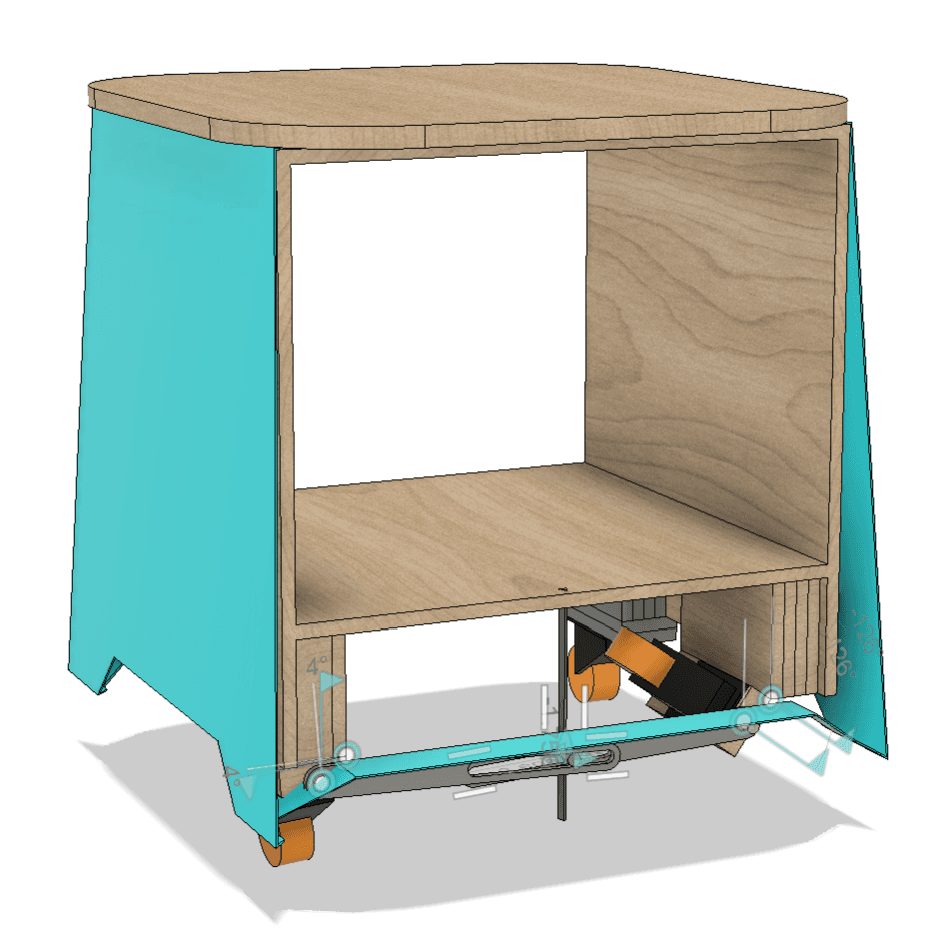
I spent a lot of time exploring mechanisms and talking to engineers, trying to find a way for the casters to deploy from a completely hidden state. It ended up out of scope for a 6.5-week project, so I left room for the casters to fold in if I come back to it later.
FINAL CAD
The final model swapped the round knobs for V-notch pulls cut right into the drawer fronts, and kept a gap under the bottom drawer where folding casters could go later.

Fabrication
PLYWOOD · LASER CUTTING · STEEL BENDING
PLYWOOD
The drawers, top, and skirt are all 0.5in plywood, since I already had a sheet left over from a home improvement project. I planned every part in a cut list first, then cut and fit the pieces.

STEEL
The sides are laser-cut sheet steel, bent on a brake. I only had one shot at bending each half, so I practiced on scrap first. I left the steel raw, since finishing was out of scope.

Laser cutting the steel sides.

Practice runs on scrap before the real bends.

Both sides bent and ready to assemble.
Final
STUDIO SHOOT · COLOR RENDERINGS · IN THE SHOP


COLOR RENDERINGS
The build stayed raw, but I rendered a few colorways to show where the pop of color could go.


Debrief
The Summary
In six and a half weeks, I took a wide-open table brief to a full-size rolling shop cart: laser-cut, bent steel sides that double as pegboard, plywood drawers with cut-in pulls, and a top that works as a surface or a seat.
What I’d Do Next
Next, I’d upgrade the drawer slides and build a thicker top with T-track routed in, so I could finally clamp work right to the tabletop like I wanted. I’d also go back to the retractable wheels. I couldn’t engineer them to work the way I wanted in 6.5 weeks, but they were the core of every concept I started with.
